Choosing the Right Membrane for Reverse Osmosis in Industrial Water Systems
In any high-efficiency water purification facility, there is one component that does the heavy lifting. While pumps create the necessary flow and pre-filters catch the raw mud, the true purification happens at the molecular level. The component responsible for this breakthrough is the membrane for reverse osmosis.
For plant managers, facility directors, and utility engineers, selecting and maintaining the right membrane for reverse osmosis is a critical operational choice. It directly impacts your system’s energy consumption, water rejection rates, and how often you face expensive downtime for chemical cleaning.
In this comprehensive guide, we will break down the science behind these advanced filters, explore the main types used in factories, and discuss how to pick the ideal setup for your business.
How Does an RO Membrane Actually Work?
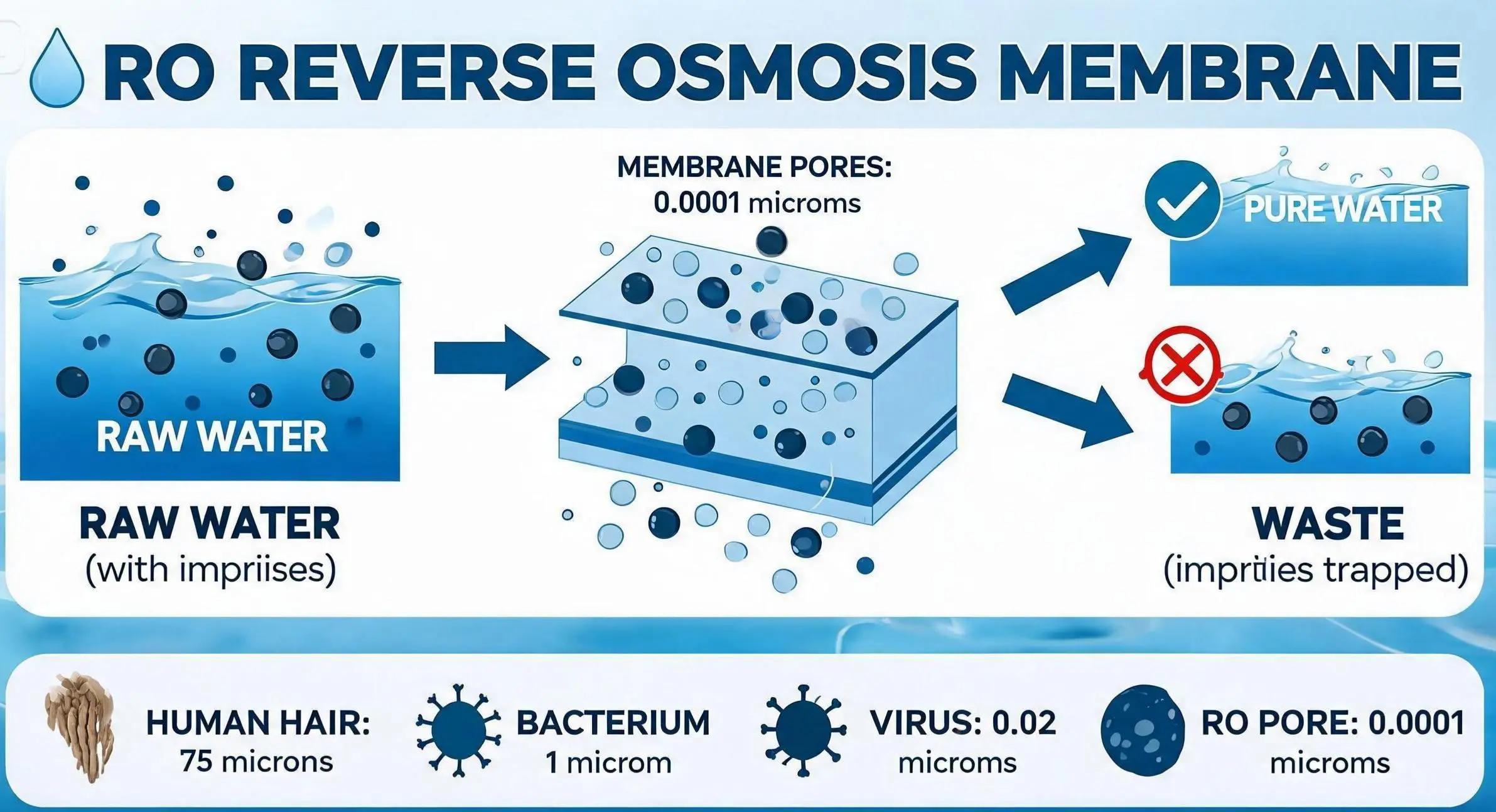
To understand the value of a high-grade membrane for reverse osmosis, we must look at its physical scale. A typical industrial RO membrane is made of thin-film composite (TFC) layers. These sheets are rolled tightly around a central perforated tube in a spiral configuration.
- [Raw Water In]

- [Microscopic Pores: 0.0001 Microns]
- [99% Dissolved Salts Blocked]
- [Ultra-Pure Water Out]

The pores on an RO membrane surface measure approximately 0.0001 microns. To put that into perspective:
- A single human hair is about 75 microns wide.
- A standard bacterium is around 1 micron wide.
- A virus is roughly 0.02 microns wide.
Driven by high-pressure pumps, water molecules are forced through these sub-microscopic openings. Because dissolved salts, heavy metals (like lead and arsenic), fluorides, and synthetic chemicals are larger than the water molecules, they are blocked. They are continuously washed away into a waste line, leaving only ultra-pure liquid behind.
Main Types of Industrial RO Membranes
Not all raw water is the same. Treating deep well water requires a different configuration than purifying salty seawater. Because of this, a membrane for reverse osmosis is manufactured in distinct specifications to handle different levels of Total Dissolved Solids (TDS):
1. Brackish Water Membranes (BW Series)
- Best Used For: Deep well water, municipal tap lines, and surface river water.
- TDS Handling Range: Generally engineered for water with low to medium salt levels (up to 10,000 ppm).
- Key Benefit: They operate at relatively lower pressures, helping industrial plants save significant electrical energy over long production cycles.
2. Seawater Desalination Membranes (SW Series)
- Best Used For: Coastal factories, offshore rigs, and marine vessels.
- TDS Handling Range: Engineered for extreme salinity concentrations (35,000 ppm or higher).
- Key Benefit: Built with reinforced structural layers to withstand the intense hydraulic pressure required to split pure water from dense sea salt.
3. Fouling-Resistant Membranes (FR Series)
- Best Used For: Wastewater treatment plants (WWTP), food processing facilities, and surface water with high organic content.
- Key Benefit: These sheets feature a special smooth surface coating that naturally prevents biological film and organic dirt from sticking to the membrane pores, reducing the frequency of chemical washing cycles.
Key Metrics for Evaluating Membrane Performance
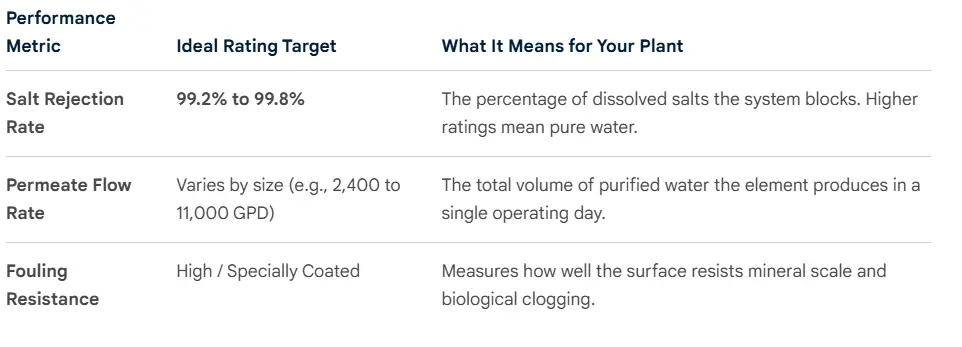
When buying or replacing elements for your water plant, look closely at these three factory performance ratings:
Operational Tips to Extend Your Membrane’s Lifespan
Replacing a full bank of industrial RO membranes is a significant capital expense (CapEx). To maximize your investment, integrate these preventative habits into your routine:
- Ensure Proper Pre-Filtration: Never let raw water hit the RO membrane directly. Maintain your sand and carbon pre-filters to remove large solids and chlorine, as chlorine will quickly chemically burn and ruin TFC membranes.
- Monitor Pressure Drops Regularly: If the pressure difference between the feed water and the concentrate waste stream increases by 15%, it means minerals or bio-film are clogging the pores.
- Perform Timely CIP (Cleaning-In-Place): Do not wait for the flow rate to drop completely before washing. Schedule routine chemical cleanings with specialized low-and-high pH cleaners to rinse away scale build-up before it permanently hardens.
Conclusion
The membrane for reverse osmosis is the ultimate guardian of your factory’s water quality. By selecting the specific type that matches your raw water source and keeping up with a tight pre-filtration routine, your facility can ensure reliable 24/7 continuous flows, protect downstream boilers from scale, and achieve lower overall operational costs.
Optimize Your RO Plant Performance with Nusa Water Treatment
Finding the exact membrane specifications for your industrial configuration requires accurate raw water testing and a deep look at your current operating pressures. If your business needs to replace worn membrane elements, troubleshoot high TDS issues, or build a new high-output automated RO system, Nusa Water Treatment is here to support you.
Nusa Water Treatment delivers tailored industrial water engineering across Indonesia—combining certified laboratory water testing with the supply of premium, high-rejection membrane elements built to handle tough industrial feeds.
Visit Nusa Water Treatment today to schedule your professional water audit and get a custom engineering consultation for your facility.