The Essential Guide to Modern Water Treatment: Technologies, Steps, and Global Importance
Water treatment is the foundational pillar of global public health, environmental sustainability, and industrial efficiency. In an era marked by rapid urbanization, climate shifts, and emerging synthetic pollutants, the methods we use to clean our most precious resource must evolve constantly. Transforming raw, contaminated water into a safe liquid suitable for drinking, manufacturing, and ecological replenishment is a complex scientific journey.
Understanding how modern infrastructure manages this cycle reveals the critical intersection between engineering, chemistry, and environmental stewardship.
Why Comprehensive Water Treatment Matters
Unprocessed water from rivers, lakes, and underground aquifers is rarely safe for immediate consumption. It naturally carries a heavy payload of organic debris, suspended solids, and microscopic pathogens. Furthermore, human industrial activities introduce complex chemical compounds, microplastics, and heavy metal residues into the water supply.
Effective water treatment serves multiple indispensable functions:
Defending Public Health: It completely neutralizes waterborne pathogens—such as bacteria, viruses, and parasites—preventing catastrophic disease outbreaks.
- Preserving Natural Ecosystems: Treating municipal and industrial wastewater before environmental discharge protects aquatic life from toxic shock and nutrient overloads.
- Supporting Global Industry: Manufacturing sectors, power generation plants, and commercial laboratories require hyper-pure process water to safeguard expensive machinery from corrosion and scaling.
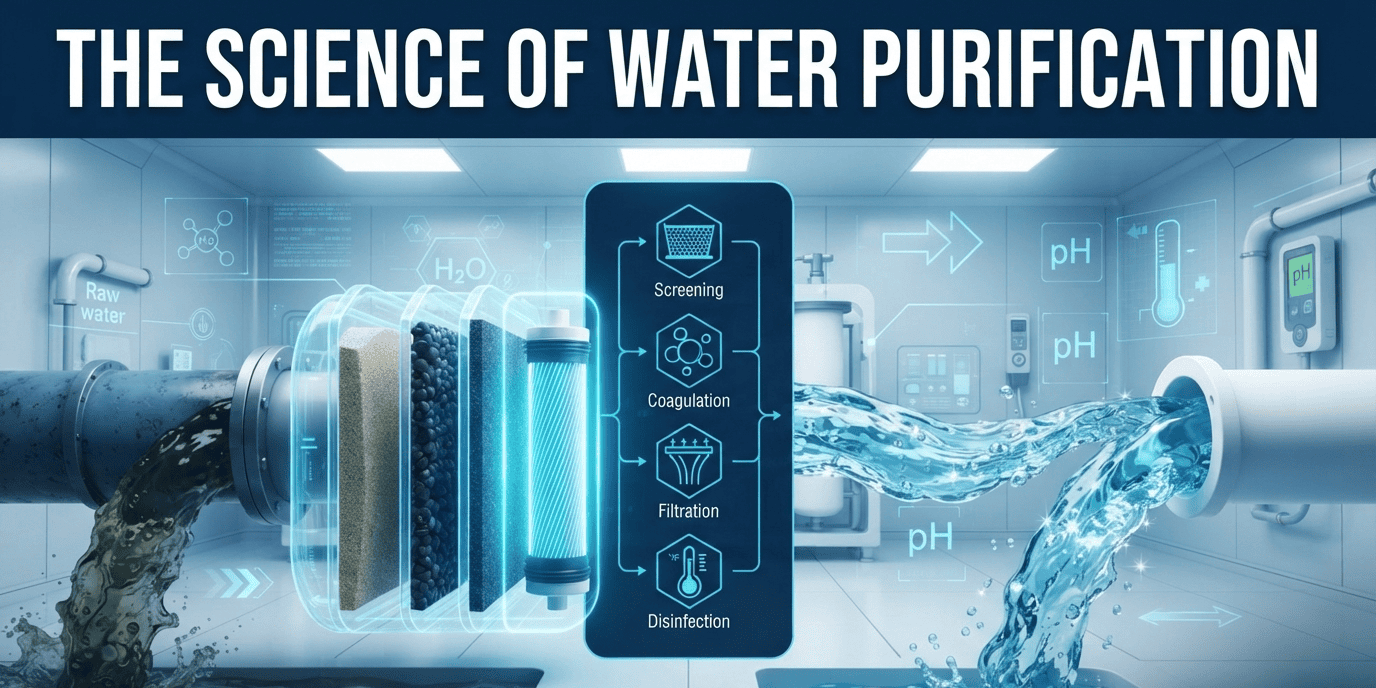
The Core Stages of the Conventional Water Purification Process
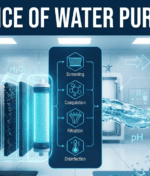
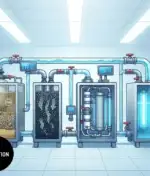
While specific facilities adapt their setups based on incoming water quality, standard drinking water production relies on a highly regulated, sequential multi-stage system:
1. Intake and Coarse Screening
The process begins at the intake point. Raw water passes through heavy metal bars and mesh screens. This initial mechanical barrier catches large floating objects like branches, leaves, plastics, and weeds, ensuring they do not jam downstream pumps or clog smaller pipelines.
2. Coagulation and Flocculation
Tiny, microscopic particles suspended in water carry negative electrical charges, causing them to repel one another and remain floating indefinitely. To solve this, operators introduce specialized chemical coagulants, such as liquid aluminum sulfate or iron salts. Rapid mixing neutralizes these charges, allowing the particles to stick together. The water then moves to a gentler mixing basin where these small particles collide and coalesce into larger, visible, and much heavier clusters known as “flocs.”
3. Sedimentation
Once massive flocs are formed, the liquid flows into vast, quiet sedimentation basins. Here, the velocity of the water drops to a crawl. Guided by gravity, the heavy clusters slowly drop out of suspension, gathering at the bottom of the tank as thick sludge. The pristine, clarified water remaining at the top is skimmed off and directed toward the next phase.
4. Deep Filtration
Even clear water contains microscopic particles that bypass gravity settling. To trap these micro-impurities, the liquid moves through deep, multi-layered filtration beds composed of fine silica sand, gravel, and crushed anthracite coal. For advanced odor and chemical removal, facilities often integrate granular activated carbon, which adsorbs organic toxins, pesticides, and unpleasant tastes.
5. Disinfection and Stabilization
The final, crucial safety benchmark is disinfection. To eliminate any lingering viruses or bacteria, facilities inject precise doses of disinfectants like chlorine or chloramines. Alternatively, modern eco-friendly sites use powerful ultraviolet (UV) light channels or ozone gas injection to destroy pathogen DNA without altering the water’s chemical makeup. Before pumping the product into city water grids, the pH level is carefully stabilized using lime or soda ash to ensure the liquid won’t corrode municipal distribution piping.
Advanced and Next-Generation Purification Technologies
Traditional systems are excellent, but modern industries and areas dealing with extreme water scarcity require advanced technological
solutions:
- Membrane Filtration Technology: This category bypasses chemical settling by forcing water through microscopic physical pores. Systems like Microfiltration and Ultrafiltration easily screen out organic molecules and bacteria.
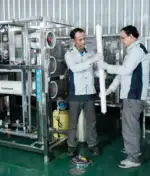
- Reverse Osmosis (RO): Operating under intense mechanical pressure, RO units force water through semi-permeable membranes that completely strip away dissolved salts, mineral ions, and heavy metals. This is the foundational technology behind modern ocean desalination and industrial water recycling systems.
- Smart and Digital Systems: Contemporary treatment facilities utilize networked Internet of Things (IoT) sensors, automated chemical dosing systems, and predictive software analytics. These tools monitor metrics like pH levels, flow rates, and turbidity in real time, preventing operational errors before they occur.
Summary
As freshwater sources face mounting strains globally, implementing robust, high-efficiency water treatment protocols is no longer optional. By combining timeless structural purification steps with cutting-edge digital tracking and advanced physical membranes, our communities can protect public health, secure stable industrial production, and build a highly resilient, water-secure future.
If your company requires tailored commercial setups, professional quality analysis, or heavy-duty operational upgrades, custom engineering solutions are readily available. For detailed professional guidance regarding your corporate utilities, technical system design, or factory-scale purification requirements, visit Nusa Water Treatment to consult with an industry expert today.